JSPS 学術知共創プログラム
JSPS Co-creation of Academic Knowledge
人口動態予測に基づく
空間格差の解消に向けたシナリオ
Scenarios for resolving spatial disparities based on demographic prediction
「人が住む場所に格差あり」。グローバル化と新自由主義の潮流のもと、世界各国の都市で空間格差(Spatial inequality)が拡大しています。本研究は、超高齢化社会に世界に先行して直面する日本を見据え、従来の人口予測モデルの限界を超える「人間活動の実態を考慮した人口動態予測モデル」を独自に構築し、精確な将来人口予測を踏まえて、あらゆる都市に必然的に起こり遍在する空間格差の課題への抜本的な対処策を検討します。
“Wherever people live, they confront inequalities.” Under globalization and neoliberalism, spatial inequality is widening in cities across the world. Looking to Japan, which faces a super-aged society ahead of the rest of the world, this project builds an original model of demographic prediction that goes beyond the limits of conventional population projections by incorporating the realities of human activity, and examines fundamental measures against the spatial inequality that inevitably arises in every city.

* Placeholder image, to be replaced with figures from our publications.
研究の目的と意義
Aims and Significance of the Research
グローバルノース・グローバルサウスを問わず、規制緩和による大規模な都市再開発と市場経済を偏重した住宅政策、福祉部門への政府支出の削減が、都市における普遍的な空間格差の原因となってきました。日本でも2000年代以降、東京への富の集中と、都市内・都市間の空間格差が進行しています。この空間格差は、世代間相続を通じて格差が継承・拡大する【世代継承要因】と、地域の経済条件の変化によって格差が継承・拡大する【地域条件要因】という二つの要因により、深刻化する危機に瀕しています。
In both the Global North and the Global South, large-scale urban redevelopment driven by deregulation, market-oriented housing policy and cuts in welfare spending have been a universal cause of spatial inequality in cities. In Japan too, wealth has concentrated in Tokyo since the 2000s, and disparities within and between cities have deepened. This inequality is driven by two factors: intergenerational inheritance, through which disparities are passed on and widened across generations, and regional conditions, through which changes in local economic circumstances reproduce and amplify them.
一方で、人口動態の予測そのものにも限界があります。従来のコーホート要因法は「結果としての人口そのもの」の変化要因(死亡・出生・転出・転入)にのみ着目し、人口に大きな影響を与える空間や環境を捨象してきました。テレワークや二地域居住など人間活動が多様化する現代においては、刻一刻と変化する【人間活動の実態】と、【人間が求める幸福】を織り込むことで、はじめて精確な将来人口予測が可能になると考えられます。
At the same time, demographic prediction itself has its limits. The conventional cohort component method looks only at the factors that change population as an outcome — mortality, fertility and migration — and sets aside the space and environment that strongly shape it. In an age of diversifying activity such as teleworking and dual-residence living, accurate projections become possible only once the moment-to-moment realities of human activity and the well-being people seek are built into the model.
本研究は、【人間活動の実態】と【人間が求める幸福】から将来人口を正確に予測する方法論の確立を探るとともに、その将来人口を踏まえて【世代継承要因】と【地域条件要因】から空間格差の抜本的な解決を探ります。対象地域を設定し、行政・住民・企業など多様なステイクホルダーと密に連携することで、机上の空論にとどまらない、社会実用性の高い学術知の創出を目指します。
This project seeks to establish a methodology for predicting future populations from the realities of human activity and the well-being people seek, and, on that basis, to find fundamental solutions to spatial inequality through the lenses of intergenerational inheritance and regional conditions. By setting study areas and working closely with government, residents and businesses, it aims to produce academic knowledge of real social utility rather than theory alone.
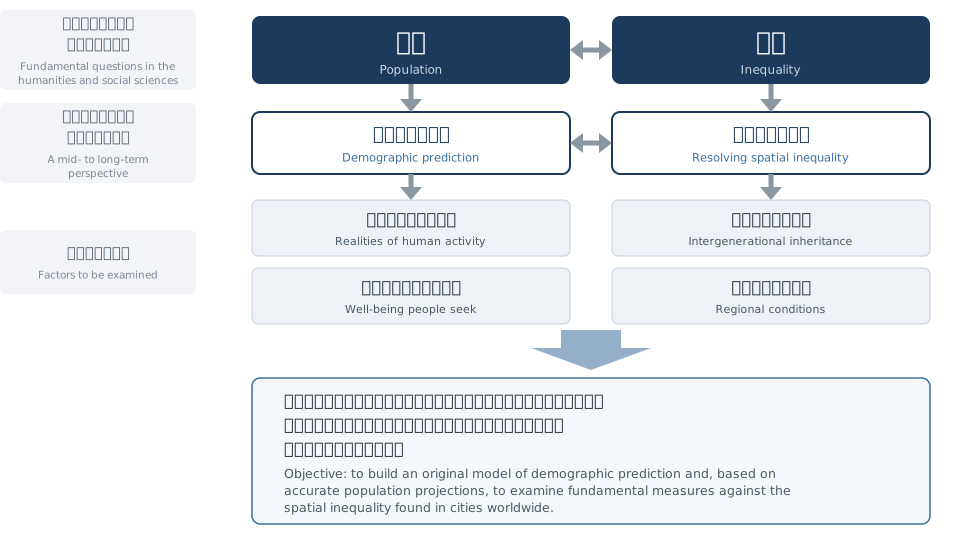
Research questions and objectives of the project
空間格差を捉える二つの要因
Two factors behind spatial inequality
世代継承要因
Intergenerational inheritance
「住宅のはしご」(Gurney, 1999)の概念的モデルに基づき、親世代の住宅所有や資産状況が子世代の持ち家取得に与える影響を検証します。対象都市の20代〜60代の現役世代に対するウェブアンケート(1都市あたり約500サンプル)をもとに、親世代との同居の有無、親世代の資産・所得水準、所有する住宅の種類などから子世代の住宅所有を説明する「世代継承要因ロジットモデル」を構築します。
Drawing on the conceptual model of the “housing ladder” (Gurney, 1999), we examine how parental homeownership and assets shape homeownership in the next generation. Based on a web survey of working-age residents in their 20s to 60s in each study city (about 500 samples per city), we build a logit model of intergenerational inheritance that explains children’s homeownership from co-residence with parents, parental assets and income, and the type of housing they own.
地域条件要因
Regional economic conditions
住環境、インフラ、住民の所得や学歴などの実態を統計データから把握し、空間格差の姿をGIS上で可視化します。とりわけ、格差を形成する根源的な要因と考えられる交通インフラの整備について「マーケットアクセス」(Donaldson & Hornbeck, 2016)の概念を用い、新幹線ネットワークの拡張が地価・所得・年齢や世帯構成別人口に与える影響を、経済面・環境面の両面から回帰モデルにより定量的に把握します。
Using statistical data, we capture housing conditions, infrastructure, income and educational attainment, and visualize spatial inequality on GIS. In particular, using the concept of Market Access (Donaldson & Hornbeck, 2016), we quantify how the expansion of the Shinkansen network affects land prices, income and population by age and household composition, through regression models covering both economic and environmental dimensions.
アプローチ
Approach
静的な人口統計データのみに依拠する従来手法から脱却し、日々の人間活動を捉えたビッグデータと主観・客観の幸福度指標を人口動態予測モデルに実装します。各対象都市の2040年・2050年・2060年時点の人口を予測し、外国人受け入れ施策について(1)現状維持、(2)現状より50%増加、(3)現状より50%減少、の各シナリオを検討します。
Moving beyond methods that rely solely on static demographic statistics, we implement big data on everyday human activity together with subjective and objective well-being indicators in the prediction model. We project the population of each study city in 2040, 2050 and 2060, and examine immigration policy scenarios: (1) the status quo, (2) a 50% increase, and (3) a 50% decrease.
人間活動の実態
The realities of human activity
スマートフォン端末の位置情報に基づくポイント型流動人口データ(人流データ)から、週間・月間・年間の人の密度、年代・性別・居住地といった属性、滞留時間や通過ルートの時系列変化を捉え、予測モデルの独立変数として取り込みます。
From point-type mobile location data (human flow data), we capture weekly, monthly and annual population density, attributes such as age, gender and place of residence, and time-series changes in dwell time and movement routes, and incorporate them as independent variables in the model.
人間が求める幸福
The well-being people seek
Liveable Well-Being City(LWC)指標の客観・主観データを活用し、市民の幸福感を高める因子を探ります。単なる人口の増減予測にとどまらず、「幸福度の高い人口をいかに増やせるか」という問いに接続します。
Using the objective and subjective data of the Liveable Well-Being City (LWC) indicators, we explore the factors that raise residents’ sense of well-being, connecting the work to the question of how to increase a population that is not merely larger but happier.
空間的な可視化
Spatial visualization
地価・所得・年齢や世帯構成別人口の分布、世代継承要因の影響度などをGIS上でレイヤー化し、5年単位の推移と将来シナリオを可視化します。小地域・自治体・都道府県それぞれが取るべき対策を検討する手がかりを提示します。
Land prices, income, population by age and household composition, and the estimated influence of intergenerational inheritance are layered on GIS to visualize five-year trends and future scenarios, offering a basis for measures at the neighbourhood, municipal and prefectural levels.
研究体制
Research structure
人文学・社会科学を軸とする中堅・若手研究者を中心に、ベテラン研究者や学生を含む国内外・産学の協働エコシステムを構築し、5つのグループの役割分担と連携により研究を推進します。
Centred on mid-career and early-career researchers in the humanities and social sciences, together with senior researchers and students, the project builds a collaborative ecosystem across institutions, sectors and countries, organised into five working groups.
理論班
Theory Group
空間格差理論構築グループ
Spatial Inequality Theory Group
文献調査を通じて、世代継承要因と地域条件要因の理論的背景と形成メカニズムを解明し、必要な理論的枠組みを提示します。
Through a review of the literature, the group clarifies the theoretical background and formation mechanisms of intergenerational inheritance and regional conditions, and presents the framework required for verification.
人口班
Demographic Prediction Group
人口動態予測モデル構築グループ
Demographic Prediction Model Group
時空間データの基盤整備とクラスタリングを行い、人流データとLWC指標を実装した人口動態予測モデルを構築します。
The group prepares the spatio-temporal data infrastructure and clustering, and builds a demographic prediction model implementing human flow data and the LWC indicators.
地域班
Regional Conditions Group
地域条件要因検証グループ
Regional Conditions Group
研究対象都市を抽出し、地価・所得・世帯構成別人口などの空間格差の推移と現状をGIS上で可視化します。
The group selects the study cities and visualizes on GIS the current state and trends of spatial inequality in land prices, income and population by household composition.
世代班
Intergenerational Inheritance Group
世代継承要因検証グループ
Intergenerational Inheritance Group
対象都市の現役世代へのウェブ調査をもとに、住宅所有や資産形成の世代間継承の実態をモデルにより解明します。
Based on web surveys of working-age residents in the study cities, the group uses modelling to clarify how homeownership and asset formation are passed between generations.
政策班
Policy Group
空間格差解消政策検討グループ
Policy Group for Resolving Spatial Inequality
都市計画・住宅・地域経済・社会福祉・金融資産に関する政策動向を分析し、空間格差の解消方策を検討します。
The group analyses policy trends in urban planning, housing, the regional economy, social welfare and financial assets, and examines measures to resolve spatial inequality.
プロジェクトの構成員は、参画メンバーのページでご覧いただけます。
The members of the project are listed on the Members page.
本研究は、日本学術振興会「課題設定による先導的人文学・社会科学研究推進事業(学術知共創プログラム)」(課題番号:JPJS00124016566)の支援を受けて実施しています。
This project is supported by the Japan Society for the Promotion of Science (JSPS), Topic-Setting Program to Advance Cutting-Edge Humanities and Social Sciences Research, Co-creation of Academic Knowledge (Grant Number: JPJS00124016566).